

John Candy Net Worth: Surprising Fortune Revealed (2026)
John Candy net worth is widely reported as an estimated $15 million at the time of his death on March 4, 1994, from a heart attack in Durango, Mexico, while filming Wagons East!. This figure appears across nearly every celebrity net worth outlet, yet it is rarely cross checked against hard evidence such as estate records, probate filings, or property transactions.
Candy built his wealth through decades in Hollywood comedy, starting with SCTV in the 1970s and moving into hit films such as Stripes, Splash, Uncle Buck, Planes, Trains and Automobiles, and Cool Runnings. He also earned income from endorsement deals, television appearances, and various business ventures. These career achievements provide important context for understanding John Candy Net Worth, although the reported $15 million figure remains an estimate rather than a verified financial total.
Quick Facts
| Category | Detail |
| Full Name | John Franklin Candy |
| Net Worth at Death | $15 million (estimated) |
| Born | October 31, 1950, Newmarket, Ontario, Canada |
| Died | March 4, 1994, Durango, Mexico (age 43) |
| Cause of Death | Heart attack |
| Profession | Actor, comedian, screenwriter, producer |
| Nationality | Canadian |
| Spouse | Rosemary Margaret Hobor (m. 1979) |
| Children | 2 |
| Resting Place | Holy Cross Cemetery, Culver City, California |
Who Is John Candy? Early Life & Background

John Candy Net Worth has its roots in a humble upbringing and a career built through persistence rather than an early breakthrough. John Franklin Candy was born on October 31, 1950, in Newmarket, Ontario, to Sidney James Candy and Evangeline Aker Candy. He grew up in a working class family of Polish and Scottish descent and attended Holy Cross Catholic Elementary School before moving on to Neil McNeil High School in Toronto, where he played football.
He briefly studied drama at Centennial College but dropped out in 1970 without graduating, a risky decision without a financial safety net. His early acting jobs were small and unglamorous, including bit parts in Canadian television and low budget films such as Tunnel Vision and Find the Lady, both released in 1976. He also had a minor role alongside fellow Canadian Dan Aykroyd in Steven Spielberg’s 1941 (1979).
The real turning point came at age 27, when he joined The Second City in Toronto. Working alongside future stars like Eugene Levy and Catherine O’Hara, Candy developed the comedic timing that would eventually take him from Canadian sketch comedy to Hollywood leading roles. This journey is central to understanding John Candy Net Worth: his fortune was not built on an early break or family money, but gradually, one small role at a time.
His story illustrates how dedication and talent can create lasting success. Ultimately, John Candy Net Worth reflects the financial legacy of a career developed through years of hard work.
Career Timeline & Key Milestones
Second City & SCTV (1970s–early 1980s)
Candy became a cast member and writer on Second City Television (SCTV), a role that built his reputation long before it built his bank account. His writing on SCTV Network 90 earned him two Primetime Emmy Awards for Outstanding Writing in a Variety or Music Program, in 1982 and 1983. Those wins gave him real industry credibility, which mattered more for opening Hollywood doors than any paycheck from television work at the time.
Hollywood Breakthrough (early–mid 1980s)
Early Ensemble Roles
Before he became a lead actor, John Candy took supporting parts in Stripes (1981) and National Lampoon’s Vacation (1983), both of which put him in front of much wider American audiences and steadily raised his profile in Hollywood.
Splash (1984)
Candy’s supporting role opposite Tom Hanks in Splash marked his first true mainstream breakthrough. It’s widely considered the film that shifted him from “recognizable comedy actor” to genuine box office draw.
Planes, Trains and Automobiles (1987)
Directed by John Hughes and co starring Steve Martin, this remains Candy’s most career defining role. A per film fee somewhere in the $1–1.5 million range circulates widely for this stretch of his career, but we could not trace that number to a primary source such as a studio filing or a contemporary trade report. So we’re not stating it as confirmed fact. No verified, sourced figure for his exact per film salary is publicly available anywhere.
Peak Earning Years (late 1980s–early 1990s)
Spaceballs and The Great Outdoors (1987–1988)
Candy took on both a lead role in Mel Brooks’ Spaceballs and a starring turn in The Great Outdoors, cementing him as one of the most bankable comedic actors of the decade.
Uncle Buck (1989)
Another John Hughes collaboration and one of Candy’s biggest commercial hits, reinforcing his standing as a reliable box office lead rather than just a supporting comic actor.
Career Range in the Early 1990s
By the early 1990s, Candy began taking more dramatic, lower profile roles, including JFK (1991) and Only the Lonely (1991), showing a deliberate effort to diversify beyond broad comedy even as some of his films underperformed. He also made a brief, now famous cameo in Home Alone (1990) as the leader of a polka band who helps Kevin’s mother get home.
Cool Runnings (1993)
Released the year before his death, this became one of Candy’s highest grossing films and continues to generate licensing and streaming income for his estate more than thirty years later.
Final Projects & Death (1994)
John Candy died of a heart attack on March 4, 1994, in Durango, Mexico, while filming the Western parody Wagons East! He was 43 years old. Both Wagons East! and Canadian Bacon, directed by Michael Moore, were released after his death, adding to his estate’s income in the years that followed.
Net Worth Breakdown by Income Source
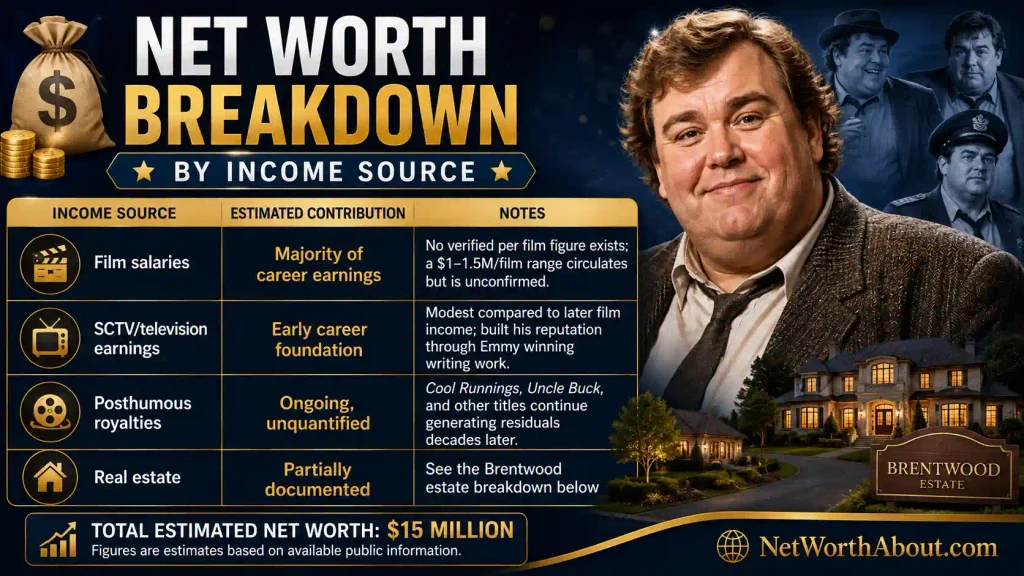
| Income Source | Estimated Contribution | Notes |
| Film salaries | Majority of career earnings | No verified per film figure exists; a $1–1.5M/film range circulates but is unconfirmed |
| SCTV/television earnings | Early career foundation | Modest compared to later film income; built his reputation through Emmy winning writing work |
| Posthumous royalties | Ongoing, unquantified | Cool Runnings, Uncle Buck, and other titles continue generating residuals decades later |
| Real estate | Partially documented | See the Brentwood estate breakdown below |
Film Salaries
Most of John Candy’s documented income came from his Hollywood run between 1981 and 1993, with his fee moving from smaller ensemble rates in Stripes and Vacation to lead actor paychecks by the time of Planes, Trains and Automobiles and Uncle Buck.
Television & SCTV Earnings
His SCTV years built his reputation and his industry credibility, including two Emmy wins, far more than they built his savings. Television comedy writing in that era simply paid less than film leads would later.
Posthumous Royalties
Several of John Candy films, including Cool Runnings, Wagons East!, and Canadian Bacon, were either released after his death or have stayed in steady rotation through syndication and streaming. That means his estate has kept earning for three decades. The exact scale of this income isn’t publicly disclosed, so we’re not assigning it a dollar figure. We’re only noting that it exists.
Assets & Real Estate
Brentwood, Los Angeles Estate
This is the single most concrete financial record connected to John Candy Net Worth and his estate. According to a Tampa Bay Times archive article dated October 12, 1996, Candy’s Brentwood home went on the market at an asking price of $5.9 million, roughly two and a half years after his death. That timing aligns with a typical estate settlement process and provides a documented reference point when assessing John Candy Net Worth.
No publicly available source confirms the final sale price, the buyer, or what became of any property he may have owned in Canada. We’re deliberately not repeating the unsourced “$900,000 Toronto property” figure that appears on some other sites. If a number cannot be traced to a real record, it shouldn’t be presented as fact. This cautious approach is essential when discussing John Candy Net Worth and distinguishing documented property information from unverified claims.
Estate Value Since His Death
Unlike a living billionaire whose net worth gets tracked every year by outlets like Forbes, there’s no reliable year over year dataset for a comedian who passed away in 1994. The one verifiable data point available is the 1996 Brentwood listing above. Everything past that point is reasonable inference, not hard data.
What this tells us about the $15 million estimate
A $5.9 million asking price for a single property, about two years after death, fits comfortably within an estate valued around $15 million once film income, personal property, and normal estate costs like agent fees and taxes are factored in. It doesn’t prove the $15 million figure is exactly right. No single data point could do that on its own. But it doesn’t contradict it either, and that’s a fairer level of scrutiny than this number usually gets anywhere else online.
John Candy vs. Chris Farley
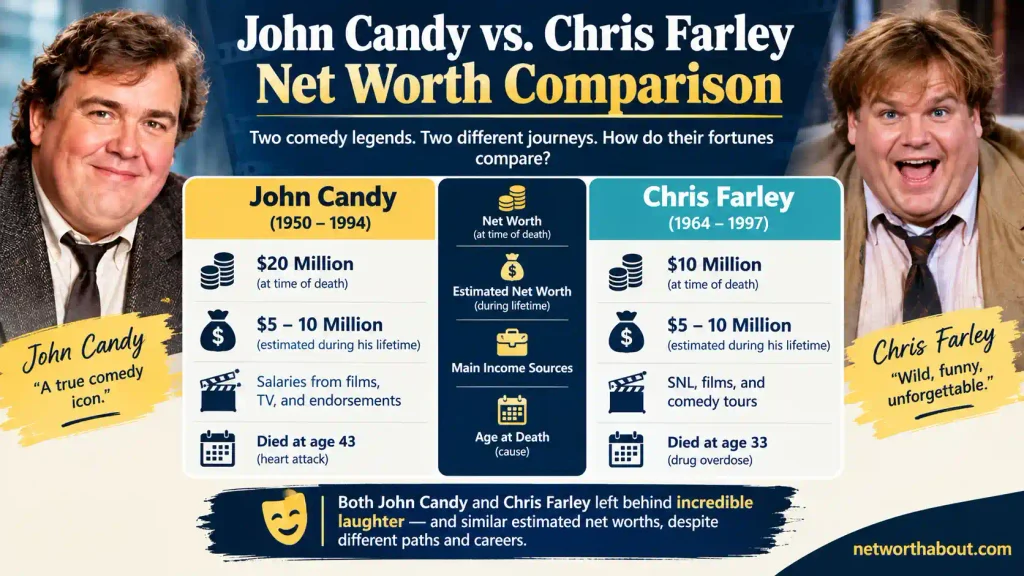
Both comedians built their fame on physical comedy, both died suddenly at the height of their careers, and both left behind estates that became part of their public legacy. This is a closer match in era and career shape than pairing her with longer career stars like Eddie Murphy or Robin Williams.
| Name | Net Worth (at death) | Profession | Primary Income Source |
| John Candy | $15 million (est.) | Actor, comedian, writer | Film salaries (Planes, Trains and Automobiles, Uncle Buck) |
| Chris Farley | $5–6 million (est.) | Actor, comedian | SNL salary and film roles (Tommy Boy, Black Sheep) |
Public Image & Legacy
The public interest in John Candy Net Worth has continued to grow alongside the enduring affection for his work. On the 25th anniversary of his passing, fellow Canadian actor Ryan Reynolds shared a tribute compilation of Candy’s most memorable performances and publicly thanked his children, Chris and Jennifer, in the process. It was a small but meaningful sign of how the Candy family has preserved his legacy without seeking the spotlight themselves.
Candy was later inducted into Canada’s Walk of Fame and featured on a Canadian postage stamp, honors recognizing his lasting cultural impact rather than his box office totals. Even three decades later, his films remain in rotation on streaming platforms, helping keep his work alive for new audiences. This continued popularity is an important part of the discussion surrounding John Candy Net Worth, as his estate’s income picture may still evolve over time. Ultimately, John Candy Net Worth remains closely connected to the legacy of a beloved comedian whose work continues to entertain audiences.
Frequently Asked Questions
What was John Candy’s net worth when he died?
John Candy’s net worth was estimated at $15 million when he died on March 4, 1994. That figure is the one most commonly cited across entertainment outlets, though it comes from media estimates rather than official records.
How did John Candy make his money?
The bulk of his income came from film salaries during his Hollywood run from the early 1980s through 1994, supplemented by earlier television writing and performing income from SCTV.
How much did John Candy get paid per film?
No verified figure for his exact per film salary is publicly documented. A range of $1 1.5 million circulates for his peak years around Planes, Trains and Automobiles (1987), but it isn’t traceable to a primary source, so it should be treated as unconfirmed rather than fact.
What happened to his estate after he died?
His Brentwood, California estate was listed for sale at $5.9 million in October 1996. No public record confirms the final sale price or buyer.
How much was John Candy’s Brentwood house worth?
It was listed at $5.9 million in 1996. That’s an asking price, not a confirmed final sale figure. No publicly available source discloses what it actually sold for.
Who inherited John Candy’s estate?
Candy was survived by his wife, Rosemary Margaret Hobor, and their two children, Jennifer and Christopher. Specific estate distribution details were never made public.
How does John Candy’s net worth compare to other comedians of his era?
At an estimated $15 million, Candy’s net worth was higher than contemporaries like Chris Farley (est. $5–6 million) but modest next to actors with longer careers, such as Eddie Murphy or Robin Williams.
What was John Candy’s highest earning movie?
Planes, Trains and Automobiles (1987) is the film most often connected to claims about his highest salary, though Cool Runnings (1993) became his highest grossing movie and still generates posthumous royalties today.
Final Thoughts
John Candy’s net worth sits at around $15 million, but no one can state that with total certainty. Where most pages simply repeat the number, this one checked the estimate against a real, dated financial record and found the two consistent, which is not the same as proof.
His story is really about steady wealth building: bit parts in Canadian television grew into lead roles in beloved 1980s and 1990s comedies, with no flashy ventures. His estate still earns from posthumous releases and streaming residuals, proving well chosen work can pay a family for decades.

Amelia Torres writes for NetWorthAbout.com, covering celebrity net worth, personal biographies, career achievements, and income sources. She focuses on making information about well known personalities accessible and easy to understand. Her articles explore the professional journeys, financial backgrounds, and major milestones that shape public figures’ lives. Amelia aims to provide readers with clear, informative content while emphasizing responsible research and the importance of distinguishing publicly available facts from estimated net worth figures.






5 Comments