Paul Mooney Net Worth: The Surprising Truth Revealed (2026)
Paul Mooney net worth stood at $500,000 at the time of his death in May 2021, according to Celebrity Net Worth. That figure looks small when you consider his career: Mooney spent five decades writing for Richard Pryor, shaping iconic shows like Sanford and Son, In Living Color, and Chappelle’s Show, and helping open doors for comedians who ended up far wealthier than he was.
This isn’t a case of missing money or bad luck. Paul Mooney net worth stayed modest because of how he built his career: as the writer behind the scenes, not the performer center stage. Understanding that single difference explains almost everything about his finances.
Paul Mooney Net Worth: Quick Facts
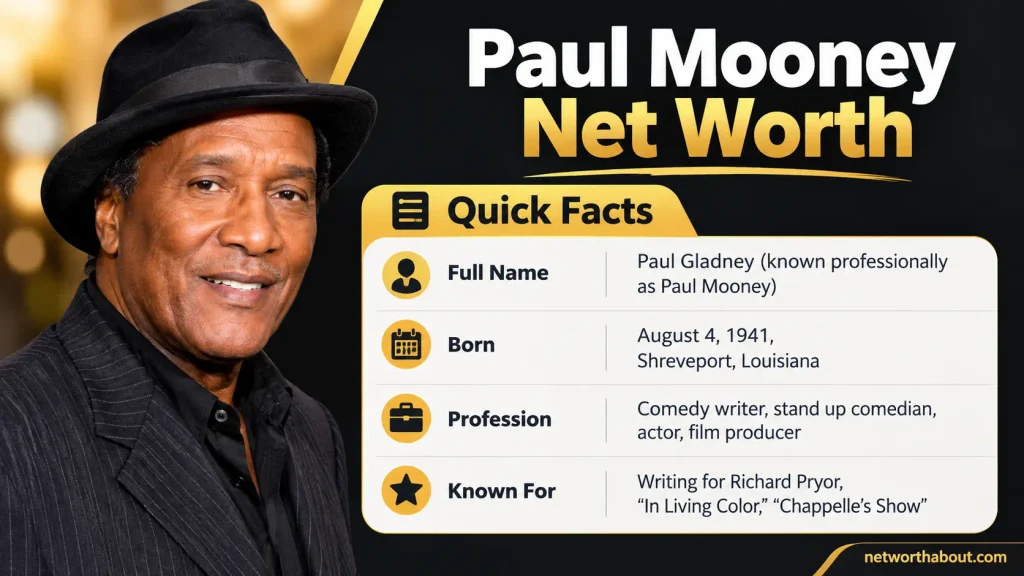
| Category | Detail |
| Full Name | Paul Gladney (known professionally as Paul Mooney) |
| Net Worth | $500,000 (at death) |
| Born | August 4, 1941, Shreveport, Louisiana |
| Died | May 19, 2021 (age 79), heart attack |
| Profession | Comedy writer, stand up comedian, actor, film producer |
| Years Active | 1970s–2021 |
| Spouse | Yvonne Mooney (married 1973) |
| Known For | Writing for Richard Pryor, “In Living Color,” “Chappelle’s Show” |
Who Is Paul Mooney? Early Life & Background
Paul Mooney was born Paul Gladney on August 4, 1941, in Shreveport, Louisiana, to George and LaVoya Gladney. When he was seven, the family moved to Oakland, California, where his grandmother, Aimay, raised him. That humble upbringing shaped much of his worldview and the sharp, no filter comic voice he later became known for.
He eventually adopted the surname “Mooney” from Hollywood actor Paul Muni, a small but telling sign of how deliberately he shaped his public identity even before fame arrived. There was no formal comedy training behind what came next, no college theater program or improv troupe. Mooney’s real entry point into show business wasn’t a stage or a writers’ room. It was a traveling circus, and that unlikely start became the foundation for one of comedy’s most influential behind the scenes careers.
Career Timeline & Key Milestones
Early Career: From Circus Ringmaster to Comedy Writer
Mooney’s first job in entertainment was as a ringmaster with the Gatti Charles Circus. It was on that circuit, not in a comedy club, that he began writing jokes and testing material on live crowds night after night. That informal apprenticeship in timing and audience reading became the base for a writing career that would eventually shape some of the most influential sitcoms and comedy specials of the next four decades.
Breakthrough: Writing for the Biggest Names in Comedy
The Richard Pryor Partnership
Mooney’s defining professional relationship was with Richard Pryor. He wrote material for Pryor’s 1975 hosting stint on Saturday Night Live, then moved on to The Richard Pryor Show and the children’s series Pryor’s Place. He co wrote material for Pryor’s stand up album Live on the Sunset Strip and co wrote the screenplay for Jo Jo Dancer, Your Life Is Calling.
This creative partnership ran across nearly two decades and shaped both men’s careers, though the money flowed very differently to each of them, a gap that sits at the center of the Paul Mooney net worth story. Pryor became one of the highest paid entertainers of his generation off the back of material Mooney helped craft, while Mooney himself kept working largely in the shadows.
Sitcom & Sketch Writing Credits
Beyond Pryor, Mooney wrote three episodes of Sanford and Son in 1972 and contributed to Good Times in 1974, two shows still regarded as groundbreaking for being the first sitcoms centered on Black families. Both series remain influential decades later, syndicated regularly and studied for their cultural impact, yet the writers who built their early scripts were paid under the flat fee arrangements standard for television at the time. In the early 1990s, he served as head writer for the first season of Keenen Ivory Wayans’s sketch series In Living Color, one of the most talked about comedy shows of that decade.
Later Career & Legacy (1990s–2021)
Chappelle’s Show and a New Audience
In 2003, Mooney wrote episodes of Chappelle’s Show and appeared on screen as the recurring character Negrodamus, introducing his brand of comedy to a generation that hadn’t grown up watching Pryor. It gave his career a second wind decades after his first breakthrough.
Film Roles, Memoir & Final Years
Mooney also built a modest acting résumé alongside his writing work. He played singer Sam Cooke in The Buddy Holly Story (1978), appeared in Robert Townsend’s 1987 satire Hollywood Shuffle, and took a supporting role in Spike Lee’s Bamboozled (2000). In 2007, he published his memoir, Black Is the New White, which detailed his partnership with Pryor and his early life in a level of detail rarely covered elsewhere.
In 2014, he was diagnosed with prostate cancer but kept touring and performing regardless, a decision that says a lot about both his relentless work ethic and his financial reality. He died of a heart attack on May 19, 2021, at age 79, closing out a career that spanned five decades of American comedy.
Paul Mooney Net Worth Breakdown by Income Source
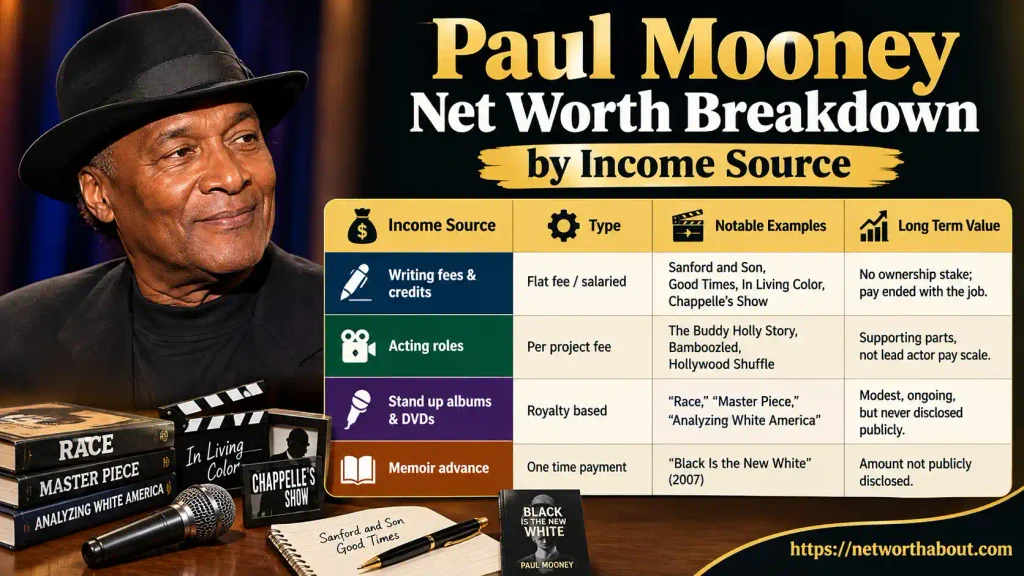
| Income Source | Type | Notable Examples | Long Term Value |
| Writing fees & credits | Flat fee / salaried | Sanford and Son, Good Times, In Living Color, Chappelle’s Show | No ownership stake; pay ended with the job |
| Acting roles | Per project fee | The Buddy Holly Story, Bamboozled, Hollywood Shuffle | Supporting parts, not lead actor pay scale |
| Stand up albums & DVDs | Royalty based | “Race,” “Master Piece,” “Analyzing White America” | Modest, ongoing, but never disclosed publicly |
| Memoir advance | One time payment | “Black Is the New White” (2007) | Amount not publicly disclosed |
Writing Fees & Credits
This was Mooney’s primary income stream for most of his career, and it’s also the biggest reason Paul Mooney net worth stayed modest. Writing credits on shows like Sanford and Son and In Living Color typically paid a flat episodic or seasonal fee at the time, nowhere close to the syndication residuals and ownership points that performers and creators with equity stakes collected for decades afterward. A writer’s paycheck stopped the moment the job ended, no matter how long the show stayed on air.
Acting Roles
Mooney’s film and TV acting work, from The Buddy Holly Story to Meet the Blacks (2016), consisted of supporting and character parts rather than lead billing. That caps the earning ceiling no matter how unforgettable the performance turns out to be.
Stand Up Albums & DVDs
His stand up releases, Race and Masterpiece in the 1990s, followed by DVDs like Analyzing White America and It’s the End of the World in the 2000s, brought in royalty income, though the exact figures were never made public.
Memoir Advance
Mooney published Black Is the New White in 2007 through a traditional publishing deal. No source discloses the advance or royalty terms attached to it, so that figure stays unverified rather than estimated.
Lifestyle & Spending Habits
Mooney was never associated with the lavish spending typical of many of his peers, and by his own account, that wasn’t accidental. In a 2009 interview with NPR, he described his lean early years living in a cheap apartment on Sunset Boulevard, “where Gladys Knight and the Pips stayed,” with people sleeping “in the bathtub or wherever they wanted.” That period clearly stayed with him long after he found success.
Decades later, speaking with the Herald Tribune, he summed up his relationship with money bluntly: “People think you’re crazy if you turn money down… people worship money… [but] money’s an illusion… because you never see a Brinks truck following a hearse.” That’s not the mindset of someone chasing Hollywood style wealth. It lines up with a career built on flat writing fees and creative freedom rather than performer level paydays, and it helps explain why Paul Mooney net worth never grew the way his cultural influence did.
Paul Mooney vs. Richard Pryor: Net Worth Comparison
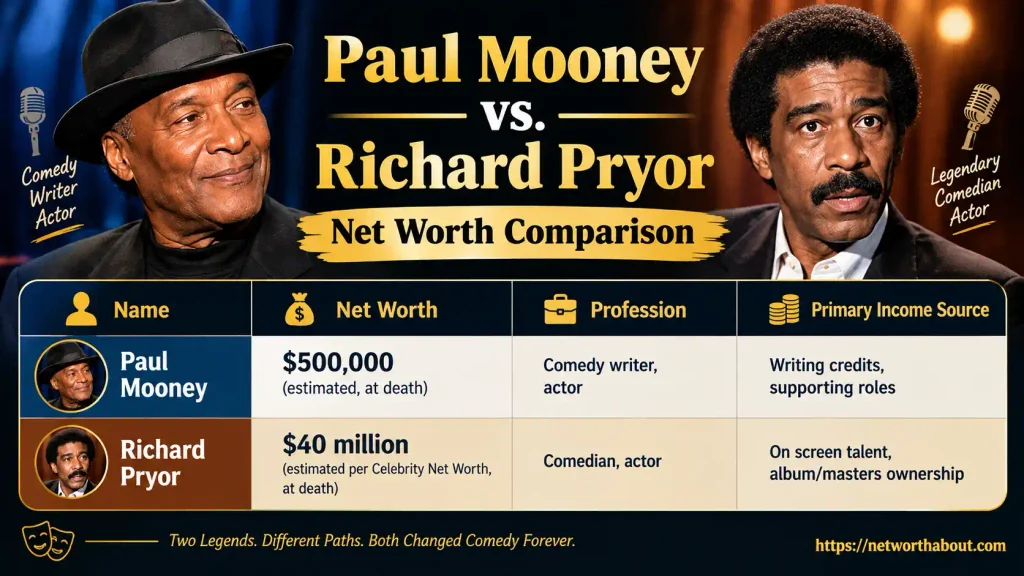
| Name | Net Worth | Profession | Primary Income Source |
| Paul Mooney | $500,000 (estimated, at death) | Comedy writer, actor | Writing credits, supporting roles |
| Richard Pryor | $40 million (estimated per Celebrity Net Worth, at death) | Comedian, actor | On screen talent, album/masters ownership |
The contrast tells the whole story. Pryor built his wealth as the performer whose name sold tickets and albums. Mooney, who wrote much of that material, was paid as staff. Same industry, same era, same creative partnership, completely different pay structures, and completely different outcomes for two men who spent nearly twenty years working side by side.
Public Image, Controversies & Legacy
Mooney built his reputation as an uncompromising social critic long before that kind of comedy went mainstream. That edge occasionally caused friction: at the 2005 BET Comedy Awards, he drew backlash for jokes about Diana Ross’s DUI arrest and the death of her ex husband, Arne Næss Jr. He also hosted BET’s 25 Most Moments in Black History special in 2006, leaning further into the racial commentary that defined his stand up work.
His 2014 prostate cancer diagnosis didn’t stop him from touring or acting, but it’s worth noting as a financial detail, not just a biographical one. Unlike writers or performers with substantial passive residual income, Mooney’s remaining income depended heavily on his ability to keep working. Slowing down meant slowing income too, not just slowing his public schedule.
His legacy, though, isn’t measured in dollars. He’s widely credited with giving early opportunities to Robin Williams, Sandra Bernhard, Marsha Warfield, and John Witherspoon, comedians whose later success owed something to the doors Mooney opened for them. Mooney shaped more comedy careers, and arguably more comedy wealth, than his own bank account ever reflected.
Frequently Asked Questions
What was Paul Mooney net worth at the time of his death?
He had an estimated net worth of $500,000 when he died in May 2021, according to Celebrity Net Worth. That figure has been independently repeated by Nicki Swift and The Cinemaholic, with no conflicting reporting from any credible outlet.
What was Paul Mooney’s main source of income?
Mooney’s primary income came from writing fees and credits on shows like Sanford and Son, In Living Color, and Chappelle’s Show, rather than from acting or stand up alone. These were largely flat or salaried payments, not ongoing royalty streams.
Why was Paul Mooney net worth so low compared to comedians he influenced?
Mooney was paid as a writer, not a performer, for most of his career. That meant flat fees instead of the syndication residuals, album ownership, and star salaries collected by people like Richard Pryor, whose material he helped shape.
Did Paul Mooney own his TV and film work?
No. His writing credits on shows like In Living Color and Sanford and Son were paid as flat or salaried work, without any ownership or royalty stake in the shows’ long term syndication value.
How did Paul Mooney make money from stand up?
He released stand up albums including Race and Masterpiece in the 1990s, along with DVDs like Analyzing White America in the 2000s, generating royalty income, though exact amounts were never publicly disclosed.
What did Paul Mooney’s memoir earn him?
He published Black Is the New White in 2007 through a traditional publisher. The advance and royalty terms attached to that deal were never made public.
Did Paul Mooney net worth grow after his death?
There’s no evidence of significant posthumous growth. Unlike performers with owned masters or syndication points, most of Mooney’s income sources ended when the work did, so his estate wasn’t positioned to generate large ongoing revenue.
How does Mooney’s $500,000 compare to other comedy writers of his era?
It’s on the lower end for a writer with his level of industry influence, largely because so much of his most famous work was credited to the performers he wrote for rather than to him directly.
Final Thoughts
Paul Mooney net worth of $500,000 doesn’t reflect the size of his influence on modern comedy, and that’s the whole point of his story. He wrote for Richard Pryor, shaped In Living Color and Chappelle’s Show, and opened doors for comedians who went on to earn far more than he ever did.
His finances stayed modest not because he lacked talent or opportunity, but because he built his career as a writer rather than a performer. That single choice explains more about his finances than any single paycheck ever could.

James Whitfield writes about celebrity net worth, public figures’ biographies, career milestones, and financial backgrounds for NetWorthAbout.com. His content helps readers explore the professional achievements and potential income sources behind well known personalities. James focuses on presenting information in a reader friendly format, with attention to clarity, context, and responsible reporting. When discussing wealth estimates, his editorial approach emphasizes the difference between verified financial information and figures that remain estimates rather than confirmed personal disclosures.