

High Net Worth Divorce Attorney: Protect Your Wealth (2026)
High Net Worth Divorce Attorney services can be essential when a divorce involves substantial wealth, complex assets, or difficult financial disputes. There is no legal dollar threshold that defines a high net worth divorce. California sets no official minimum, and many attorneys use $1 million in combined assets as a general starting point. By comparison, one widely cited measure places the top 1% of U.S. households above $10.3 million.
However, wealth alone does not determine how complicated a divorce becomes. This guide explores three wealth tiers, explains which legal and financial experts may be needed, outlines the divorce process, and reviews realistic legal costs for 2026, including potential tax issues after the judgment.
Quick Facts
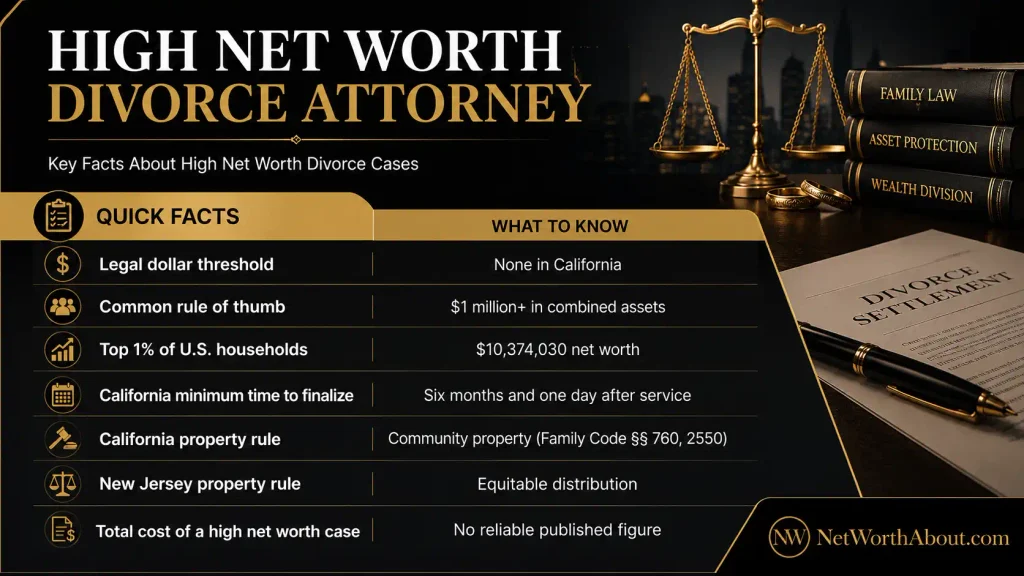
| Item | What to Know |
| Legal dollar threshold | None in California |
| Common rule of thumb | $1 million+ in combined assets |
| Top 1% of U.S. households | $10,374,030 net worth |
| California minimum time to finalize | Six months and one day after service |
| California property rule | Community property (Family Code §§ 760, 2550) |
| New Jersey property rule | Equitable distribution |
| Total cost of a high net worth case | No reliable published figure |
What Counts as High Net Worth in a Divorce? The Tier Breakdown
A High Net Worth Divorce Attorney often handles cases involving $1 million or more in assets, but that figure is repeated everywhere despite important caveats. Some lawyers describe it as the low end of the spectrum today, while others emphasize that there is no universal threshold and that estates can reach tens of millions of dollars.
Consider two hypothetical couples. One has $10 million spread across index funds, a paid off home, and retirement accounts. The other has $3 million, but $2.2 million is tied up in private company stock, alongside unvested RSUs and a family trust. The first divorce may involve relatively straightforward calculations. The second could require a business valuator, a carefully designed tax strategy, and a high stakes dispute over whether trust income should count toward support.
This is why choosing a High Net Worth Divorce Attorney involves more than looking at the dollar figure: the complexity of the assets can make all the difference.
| Tier | Typical Net Worth | Typical Assets | Experts You’ll Likely Need |
| 1. Conventional wealth | About $1M–$10M | Home equity, retirement accounts, brokerage accounts, maybe a small business | Attorney, possibly one appraiser |
| 2. Complex mid range | About $1M–$10M, mostly illiquid | Private company stake, RSUs, options, trusts, multiple properties | Business valuator, forensic accountant, tax advisor |
| 3. Ultra high | $10M+ | Multiple entities, private equity or hedge fund interests, trusts, family offices | Full team, including estate planning counsel |
Business ownership, hedge fund and venture capital stakes, trusts, and family offices are the assets that most often push a case into more intricate territory. Estates in the hundred million range often add offshore holdings and dynasty trusts to the mix.
Prenuptial and Postnuptial Agreements: The First Line of Defense
High Net Worth Divorce Attorneys are shaped years before anyone files paperwork. A well drafted prenuptial agreement can define upfront which assets stay separate property, how a family business will be treated, and what happens to appreciation on premarital investments. Couples who marry later in life, remarry after a previous divorce, or bring significant assets into the relationship are the ones most likely to have one in place.
A postnuptial agreement, signed after the wedding, serves a similar purpose and often comes up when one spouse starts a business, receives an inheritance, or takes on equity compensation mid marriage. Courts generally enforce these agreements as long as both sides had independent legal counsel, full financial disclosure was made, and the terms weren’t unconscionable at the time of signing.
Without one, the tiered process described above becomes the default path, and disclosure and valuation take on far more weight.
How a High Net Worth Divorce Attorney Unfolds
Before You File
Decisions made before filing can matter as much as anything that comes after. Pre separation planning is its own phase: documenting which assets are separate versus community property, and preserving account histories and business valuations before things get contentious. California also imposes a mandatory wait: a divorce cannot be finalized until six months and one day after service, even if both spouses agree on every term.
That window doubles as time to organize records and set clear goals rather than react.
Disclosure and Valuation
Both spouses must disclose all assets, debts, income, and expenses, and in a high net worth case this process can stretch out for months. The work generally breaks into three steps: figure out what needs a professional valuation, decide which assets you actually want to keep, then negotiate how to divide the rest.
Two assets with identical market value can affect your financial future very differently, so the “keep or trade” decision matters as much as the number on the page.
Income is its own separate fight. K, 1 distributions, trust payments, and business paid personal expenses can all count as income for support purposes. Passive interests, phantom income, and trust distributions are common flashpoints that push these cases into forensic accounting territory.
Negotiation, Mediation, or Trial
A high net worth divorce attorney can help couples resolve complex financial disputes through negotiation or mediation, with a trial reserved for cases where settlement talks break down. Property disputes are among the leading reasons a divorce may end up in court, and litigation can quickly increase both costs and emotional stress.
Mediation often gives both parties greater control over scheduling and confidentiality than a courtroom does. For couples with complex or sensitive assets, a skilled High net worth Divorce Attorney can help navigate financial negotiations and pursue a more private and less stressful resolution.
After the Judgment
The tax bill can show up well after the settlement is signed. Selling off assets to satisfy a settlement may leave one spouse owing capital gains tax, and retirement assets divided through a QDRO carry their own post divorce risk if handled incorrectly. Some families work toward out of court arrangements that let children still benefit from the family’s legacy while both spouses keep reasonable access to funds.
What a High Net Worth Divorce Costs
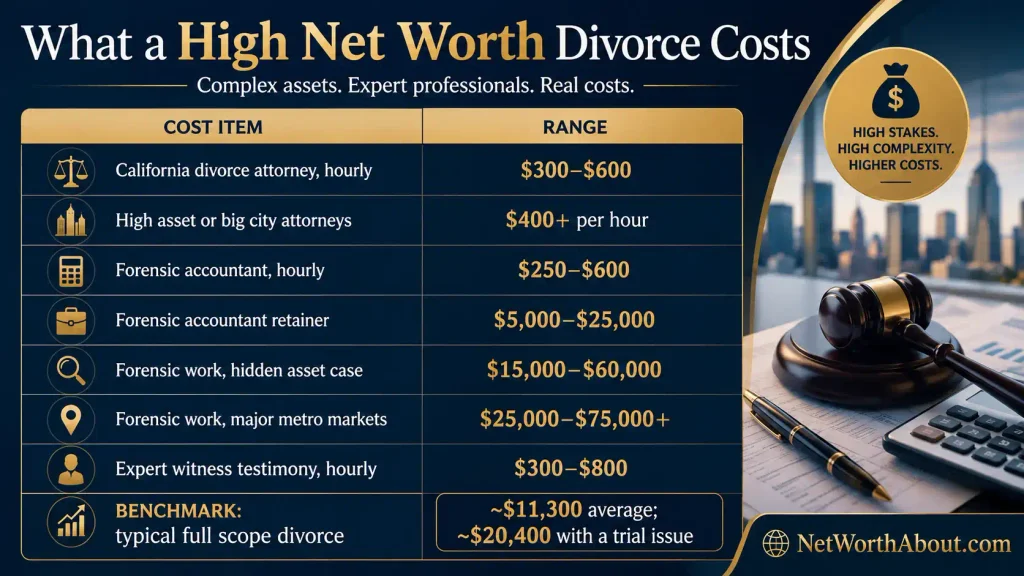
No single reliable total is published for a High Net Worth Divorce Attorney divorce, so it’s more useful to break the cost down piece by piece. The figures below come from family law and forensic accounting industry guides rather than a neutral survey, and they skew toward major California markets; treat them as estimates, not guarantees.
| Cost Item | Range |
| California divorce attorney, hourly | $300–$600 |
| High asset or big city attorneys | $400+ per hour |
| Forensic accountant, hourly | $250–$600 |
| Forensic accountant retainer | $5,000–$25,000 |
| Forensic work, hidden asset case | $15,000–$60,000 |
| Forensic work, major metro markets | $25,000–$75,000+ |
| Expert witness testimony, hourly | $300–$800 |
| Benchmark: typical full scope divorce | ~$11,300 average; ~$20,400 with a trial issue |
The benchmark row is the useful comparison point. A typical divorce averages around $11,300, yet a single forensic accounting engagement in a high net worth case can cost more than that entire ordinary divorce. That’s the real price of complexity, and it’s why which tier your case falls into matters more than the headline net worth figure.
Who ends up paying can also shift. Courts can order the spouse who controls the household finances to cover the other side’s expert retainer, and a spouse found to have hidden assets or obstructed discovery may be ordered to reimburse the full forensic bill.
Asset by Asset: What Makes Each One Hard
| Asset | Why It’s Tricky | Who Weighs In |
| Business interests | Valuing a private company, then deciding to sell, buy out, or offset | Business valuator, forensic accountant |
| RSUs and stock options | Vested vs. unvested status, multi year grants, community property classification | Attorney, valuation expert |
| Trusts | Separate property trusts and inheritance rights; trust payments may count as income | Estate planning counsel |
| Retirement accounts | QDRO handling and tax impact | Attorney, tax advisor |
| Real estate | Capital gains exposure when sold | Appraiser, tax advisor |
| Intellectual property | Includes entertainment and royalty revenue | Valuation expert |
Equity compensation deserves extra attention. Tech sector divorces increasingly involve RSUs, a mix of vested and unvested options, and deferred compensation tied to multi year grant schedules. A net worth that looks modest on paper can still hide a lot of complexity once these pieces are unpacked. Collectibles, art, and cryptocurrency holdings are also showing up more often in disclosure filings, and each carries its own valuation headache.
Crypto in particular needs a specialist who can trace wallet activity and account for price swings between the date of separation and the date of division.
California vs. New Jersey: Same Assets, Different Rules
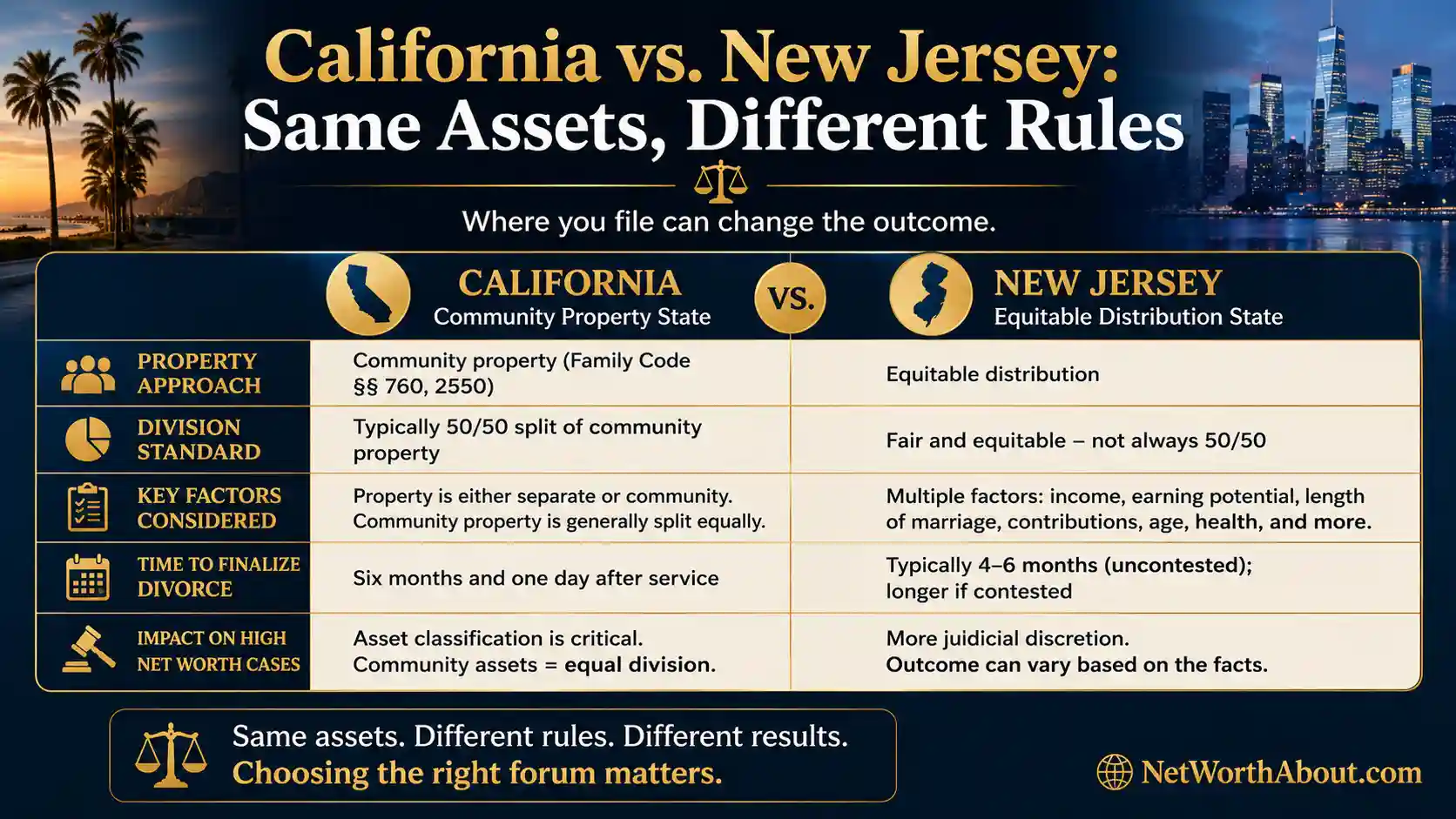
The same asset can be treated very differently depending on the state. California follows community property, splitting marital assets according to Family Code rules. New Jersey follows equitable distribution, which is fair but not necessarily equal. California weighs marital standard of living heavily in support decisions, while New Jersey looks at income, lifestyle, marriage length, and earning capacity together.
Marital standard of living is one of the more contentious points in California cases. The spouse requesting support tends to describe a higher standard of living than existed; the paying spouse tends to describe a lower one. Overreaching in either direction tends to cost credibility fast in front of a judge.
In New Jersey, because distribution is equitable rather than automatically equal, the court has more room to weigh each spouse’s contribution to the marriage and future earning potential, which can produce a very different split even from a similar sized estate.
Keeping a High Net Worth Divorce Attorney Private
Wealth usually comes with a strong desire for privacy and protection, but divorce proceedings are generally public by default. A High Net Worth Divorce Attorney can help clients explore legal options for protecting sensitive financial information. Attorneys may request protective orders or confidentiality agreements to limit what gets disclosed on the record. Another common option is staying out of court entirely; mediation or collaborative divorce can help keep private financial details from becoming part of a public case file.
Some firms specifically represent clients with public profiles across finance, entertainment, and sports. If privacy is a priority, choosing an experienced High Net Worth Divorce Attorney is an important step. Ask any prospective attorney how they handle confidentiality, asset protection, and sensitive financial disclosures before signing an engagement letter.
Frequently Asked Questions
How much net worth makes a divorce high net worth?
There’s no legal cutoff. Lawyers commonly use $1 million in combined assets as a starting point, but complexity matters more than the number itself. A $3 million estate built around a private company can be harder to divide than a $10 million portfolio of index funds.
What does a high net worth divorce attorney do?
They identify, value, and divide complex assets, and coordinate with CPAs, forensic accountants, and estate planners. Disclosure compliance and tax planning alongside your existing tax team are usually part of the job too.
How much does a high net worth divorce cost?
No reliable total figure is published. Attorney rates in California run roughly $300–$600 an hour, and forensic accounting alone can reach $15,000–$75,000 in complex cases. These are estimates, and your case may land outside these ranges.
How are business interests divided in a high net worth divorce?
It depends on whether the business counts as community (marital) property or separate (non marital) property, and on how it’s valued. Options include selling the business, one spouse buying out the other, or offsetting its value against other assets.
Are stock options and RSUs divided in divorce?
Yes, they can be. Community property rules in California determine how vested and unvested options and RSUs get characterized, and grant schedules spanning several years make the calculation more complex.
Can a high net worth divorce be settled without going to court?
Yes. Many cases resolve through negotiation or mediation rather than trial. You’ll still want counsel to confirm any settlement is fair and legally enforceable before signing.
Does a prenuptial agreement still hold up in a high net worth divorce?
Generally yes, as long as it was signed with full financial disclosure, independent legal counsel for both parties, and reasonable terms at the time. Courts can set aside agreements that were signed under pressure or without proper disclosure.
Final Thoughts
A high net worth divorce Attorney isn’t defined by the number on your balance sheet; it’s defined by how many moving parts that number hides. A straightforward $10 million estate can move faster than a tangled $3 million one built on business equity and trusts. Before hiring anyone, know which tier your case falls into, since that shapes your legal team, timeline, and final bill more than your net worth does.
Getting organized early, knowing which experts you need, and asking the right questions before signing an engagement letter make the biggest difference in how smoothly things go.

Daniel Osei contributes to NetWorthAbout.com by writing about celebrity wealth, career development, biographies, and sources of income. His work explores how public figures establish their careers, achieve recognition, and build their financial profiles. Daniel aims to present complex information in straightforward language so readers can better understand the people behind the headlines. He values clear explanations, careful research, and transparent reporting, particularly when discussing estimated net worth and financial information that is not publicly confirmed.






One Comment